

Context
The CEO gave us 6 weeks to launch an AI product in time for Christmas
After my strategic proposal (breakdown here) was well received; the CEO immediately asked to have it put into action.
The first initiative being an AI personal shopper, which needed to be live by the time our customers were shopping for Christmas…
…Which was in 6 weeks time.
So a small team including a product manager, product designer (that's me), and 3 back-end and 3 front-end engineers designed and launched The Curator—
A conversational AI tool that lived within the app to help customers find the perfect gift…
Objectives
The MVP's goals
Alongside the CEO, Head of Marketing, and Head of Product, we determined the key goals for this minimal viable product launch were the following:
Research
Existing shopping AIs were lazily executed
As promising as AI in e-commerce sounded, when researching other companies that had already launched an AI tool—
It was clear that in practice, the idea had not yet found product market fit…
The two main ways we found AI had already been integrated:
1.
A generic site-wide chat assistant


The idea of an assistant being available where ever you went had great promise—
But the early-maturity of its execution meant that the AI rarely had the proper contextual knowledge to be immediately useful…
And with only 6 weeks to build an AI that our customers might use once, and then never again if it wasn't useful—
We couldn't afford to take this more generic approach.
The other way was to…
2.
Integrate it into search


This had more potential for its purpose to be understood by customers (and therefore used) since it was accessible at the point of search—
Which customers were already using…
But as it directly conflicted with the role search already played, it was ultimately unclear when you'd choose to use the AI search—
—And when you'd use traditional search.
This put the two at conflict: a risk that would also be hard to sell within the company since so much of our existing purchases came from search.
Update (Sep 2026):
Shopify's Shop app has since made the AI part of a secondary result route that doesn't get in the way of traditional search results, nor does it ask the user to explicitly say what the result is.


Signal
A tool users were already using…
From a product market fit survey data—
We already knew that many of our most retained customers
used multiple favourites folders…
And from customer interviews, we learned that these folders were used to organise gifting ideas for occasions and recipients:

There was a signal worth chasing…
Product Vision
An AI that helped you complete jobs
From the way customers were already using favourites—
We could see there was potential in making this AI tool useful—
By supporting this job of creating gifting shortlists.
But since one of our goals was to:
Build foundations for user retention
We started to see a vision for where customers might be able to easily create shortlists not just gifting, but for any task…
After all our marketplace gave us a product range that included:
Home decor, fashion goods, alternative food products, stationary, wedding decor, games, and more...

The potential seemed to lie in the fact that we could surface any of our products by capturing the jobs people wanted to do…
Technology
In order to achieve this vision the AI's architecture had to understand the greater context of a customer's need (be it to get a leaving gift for a colleague or to decorate a particular room in your new home)—
—As well as have full grasp of our entire product catalogue and each product's data to help make an assessment of a product's relevance to the customer's need.
Which in itself, really highlighted the potential value in a conversational AI tool vs traditional search:

This ultimately led to the tech team building an architecture that facilitated the following tasks:
Shopper
“Gift for my gardening dad?”
Talk
Real-time, in both directions
Live chat
Replies stream word by word
Think
Simple agents, one job each
Guardrails
Stays on brief
Introduce
Greets, clarifies
Search
Finds products
Review
Picks the best
Find
Answers drawn from the real catalogue
Product search
Matches products by meaning
Delivery dates
Checks it arrives in time
Each stage required the following:
Talk:
WebSocket API on API Gateway,
with Lambdas streaming the agents' replies.
Think:
Mastra workflow orchestrating the agents on OpenAI's Conversations API. The agents call your services through an MCP schema (filters, search phrases, pagination).
Find:
The product service wrapping OpenSearch with OpenAI embeddings, plus the delivery settings service.
Product Design
Designing a useful shop AI
The Curator, as we were advised by the brand team to name it, found the best handful of products for your required job:

Recognising that this was meeting customers at quite a low-to-medium place of intent, especially when framed around a job:
We added a plus button on each of product result, so users could quickly sift and add their favourite suggestions to a single, refined place to then pick their final choice from.


This respected the fact that the purchase decision might not happen right away—
So we wanted to give customers a way of quickly jumping back into a shortlist of products without having to go though a
text-heavy AI chat again to get up to speed every time.
This also helped acknowledge how users were using favourites folders for reoccurring jobs—
Since mum has a birthday every year…
So the entry point that made most sense for this then was in the Favourites tab, renamed 'My Stuff' tab to leverage the Endowment Effect and encourage user ownership
(something that easily gets lost with AI results).
My Stuff now featured 'Shortlists' then, as well as 'Favourites'…
Product Design
AI shortlists? ❌
Human shortlists with AI assistants ✅
Since the relationship between the AI and the jobs you were making was so intertwined—
We decided that instead of having either one long chat, or having to educate customers to use separate chats…
We built Shortlist folders around a single chat context.
This meant that users would be able to easily rediscover products based on their context/job easily;
And if they wanted to start another job, they'd explicitly do so, rather than needing to remember to start a chat from a single chat window.
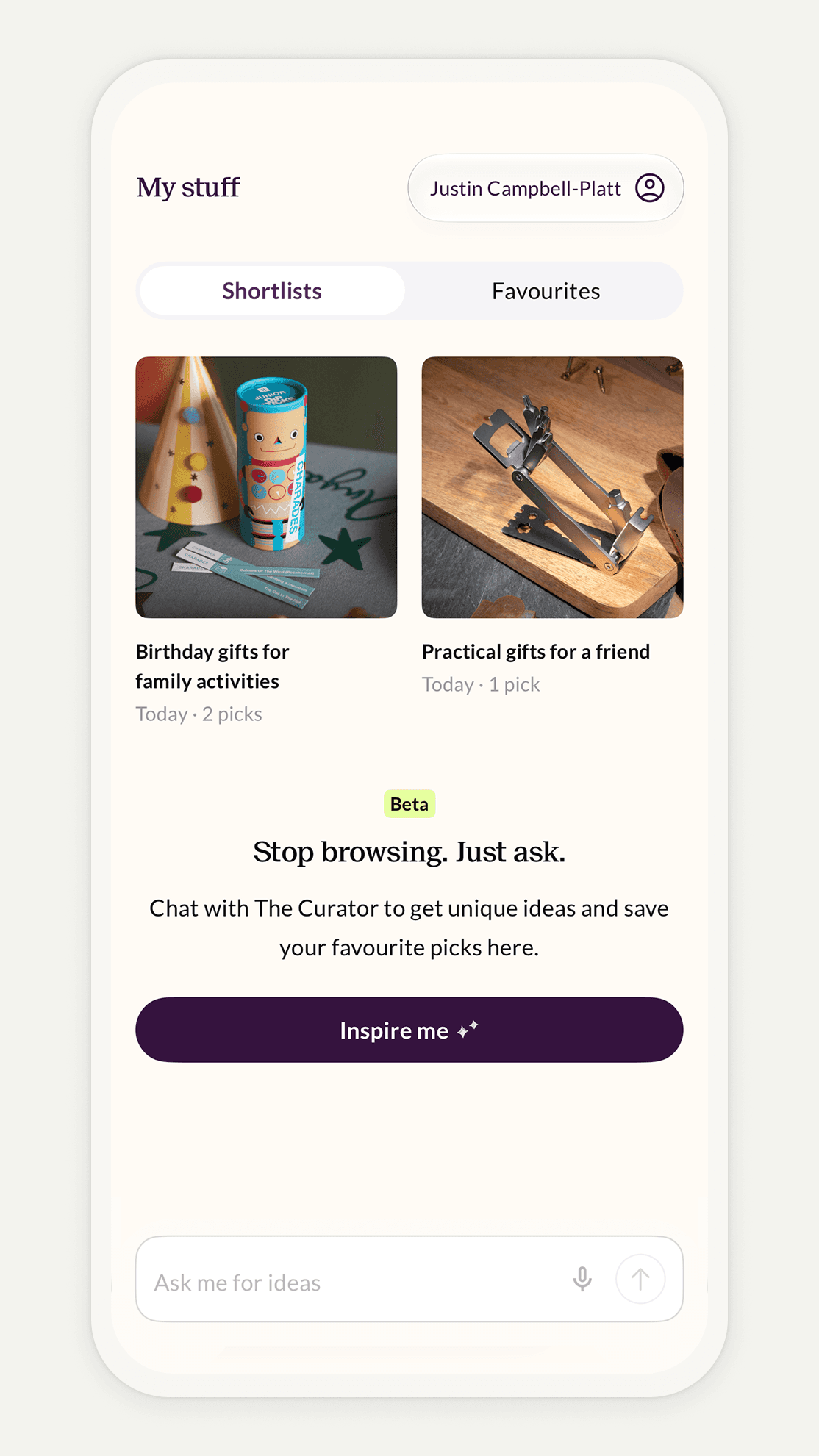

And whilst this is a great end state, this hid the AI feature behind a boring folder tool that looked no different from favourites…
So for users who had never used the AI, we surfaced The Curator tool and its capabilities before introducing shortlists—
Meaning all first time interactions started with just a single chat!


It was only after getting product suggestions from the AI, and specifying that you like one, that a user is told that this adds it
to a shortlist.
Collapsing the chat now shows that the chat lives within a shortlist folder, one automatically named by the AI using the chat's context.
Update Sep 2026:
We now have plans to merge Shortlists with Favourites, since the separation caused confusion and we can now more reliably support Curator living in a legacy tool (something we couldn't risk in 6 weeks).

“Justin is more than a designer - he is a true product partner. Someone who take lead of initiatives and helps define the strategic roadmap. With Justin, you get someone who treats your business like his own.”
Head of Product & Data, NOTHS
